
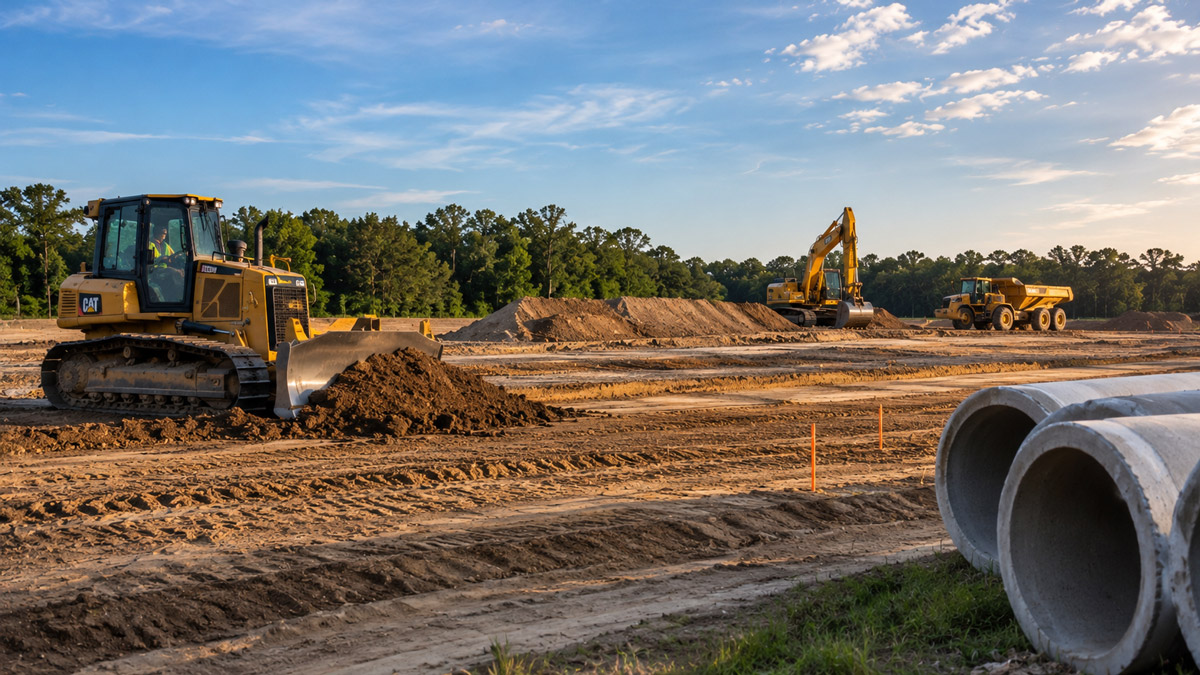
Commercial site development is the process of preparing land and installing essential infrastructure so a property can support its intended construction and long-term use.
For developers planning warehouses, industrial facilities, commercial centers, and residential communities in Central Florida, preparing land involves far more than clearing trees or leveling dirt. The process requires coordinated earthwork, drainage, utilities, access, and paving based on the project's engineered plans.
What are the stages of commercial site development?
The commercial site development process typically includes preconstruction planning, land clearing, excavation and mass grading, stormwater drainage, underground utilities, road construction, and concrete and paving.
These stages are connected. The exact construction sequence depends on the property's conditions, approved engineering plans, permits, inspections, and project requirements.
1. Site evaluation and preconstruction planning
Before construction begins, the project team must understand the property. Topography, soil conditions, drainage, access, existing utilities, and environmental considerations can all influence the development plan.
Surveyors, engineers, and other project professionals establish the plans and specifications that guide construction. Site contractors may assist with constructability reviews, earthwork planning, scheduling, and coordination before field operations begin.
Early coordination can help identify potential conflicts involving grades, drainage, utility locations, and construction access before they affect later work.
2. Land clearing and initial site preparation
Once required approvals and protective measures are in place, crews can begin preparing the site. Depending on existing conditions, this work may involve vegetation removal, grubbing, demolition, erosion-control measures, and establishing construction access.
An undeveloped industrial property may require extensive preparation, while a previously developed commercial parcel may involve different challenges. Each project must follow its approved plans and applicable requirements.
3. Excavation and GPS mass grading
Mass grading reshapes the land to establish the elevations and contours specified by the engineering design. Crews excavate, move, place, and compact soil to prepare building areas, roads, drainage features, and other site improvements.
The work must account for soil suitability, cut-and-fill quantities, compaction requirements, and drainage. GPS-guided equipment can help operators work toward planned elevations across large construction sites.
Salser Construction performs excavation and GPS mass grading as part of its commercial site development capabilities in Central Florida.
4. Stormwater drainage and underground utilities
Drainage and underground utility systems are essential components of many commercial developments. Depending on the project, crews may install stormwater infrastructure, water lines, sanitary sewer systems, and related structures.
Utility installation must be coordinated with grading, road alignments, existing infrastructure, and inspections. Trench backfill and compaction also matter because subsequent improvements may be built above these areas.
Completing required testing and inspections at the appropriate stages helps prevent underground work from interfering with later construction.
5. Road construction and site access
Commercial developments require access infrastructure appropriate to their intended use. Road construction may include preparing subgrades, placing base materials, building entrances, and coordinating drainage and paving.
For warehouses and industrial facilities, truck circulation and connections to surrounding roads are important considerations. Road construction must follow approved engineering plans and applicable specifications.
6. Concrete, paving, and final site improvements
As the major earthwork and underground infrastructure operations progress, crews can complete the appropriate concrete and paving activities. Depending on the project, this may include curbs, sidewalks, parking areas, road surfaces, and other specified improvements.
Final paving is often coordinated with the broader construction schedule to limit unnecessary damage from continuing heavy equipment traffic.
Salser performs concrete and paving with its own crews, helping coordinate these activities with the company's broader site development operations.
How long does commercial site development take?
There is no universal timeline for commercial site preparation. The duration depends on acreage, earthwork quantities, existing conditions, weather, underground utility requirements, inspections, material availability, and project complexity.
A smaller commercial parcel with limited infrastructure requirements may need substantially less work than a large industrial development with extensive grading, stormwater systems, and new roads.
Developers should request a project-specific schedule that identifies major phases, dependencies, and assumptions instead of relying on a generic estimate.
Why coordination between sitework crews matters
Commercial site development is a connected sequence of operations. Grading affects drainage. Underground utilities influence roadwork. Concrete and paving depend on earlier activities meeting the project's requirements.
Contractors with established in-house crews may have greater direct control over staffing, equipment allocation, and transitions between construction phases.
Family-owned since 1998, Salser Construction has completed more than 500 projects and performs approximately 90% of its work in-house. The company also has material resources through Shores Sand Mine LLC and Newberry Limestone LLC, which supply Salser projects and outside customers.
What should developers confirm before sitework begins?
Before construction starts, developers should work with their project teams to confirm approved plans, permits, contractor scope, construction access, utility coordination, inspection responsibilities, schedule assumptions, and procedures for addressing unexpected field conditions.
Clearly defining these responsibilities helps developers evaluate proposals and coordinate the work that follows.
Preparing the ground for what comes next
Commercial site development creates the physical foundation for the next phase of construction. From initial preparation and mass grading to underground utilities, roads, and paving, each stage must support the approved design and intended use of the property.
For developers planning projects in Ocala, Marion County, and throughout Central Florida, Salser Construction provides comprehensive commercial site development services backed by decades of field experience.