
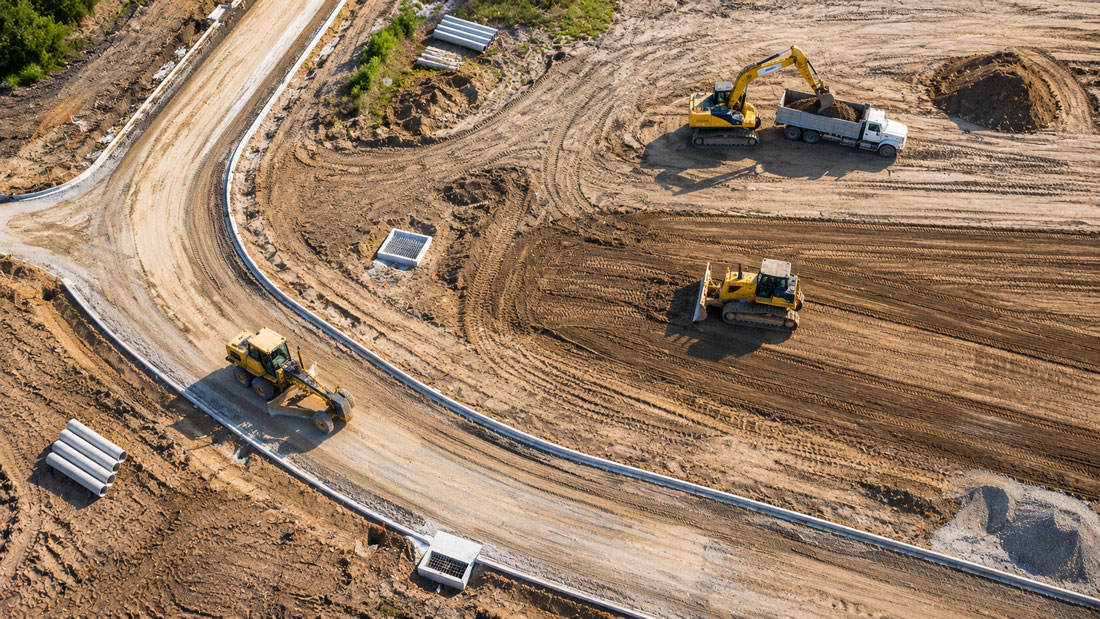
A self-performing site development contractor completes substantial portions of construction using its own employees, equipment, and operational resources rather than subcontracting every major phase to outside companies.
For commercial developers, the distinction matters. Preparing a property for construction requires multiple interconnected operations, from excavation and grading to underground utilities, roads, concrete, and paving. How these activities are managed can influence scheduling, accountability, communication, and project execution.
Understanding the advantages and limitations of a self-performing contractor can help developers make better-informed decisions when selecting a sitework partner for industrial, commercial, and residential developments.
What does self-performing mean in construction?
Self-performing construction means a contractor uses its own workforce and resources to complete designated portions of a project. Rather than relying entirely on subcontractors, the contractor directly manages the people and equipment responsible for that work.
In commercial site development, self-performed operations may include clearing, excavation, GPS mass grading, underground utilities, road construction, concrete, and asphalt paving.
Self-performing does not necessarily mean a contractor completes every task without outside assistance. Specialized work, project-specific requirements, or workload conditions may still call for subcontractors. The important consideration is which portions of the project the contractor can directly execute and manage.
1. Greater control over construction scheduling
Commercial site development involves a sequence of operations that must be carefully coordinated. Grading affects drainage. Underground utilities must be installed before certain roadway and paving activities. Concrete work depends on the completion of appropriate preparation and infrastructure.
When a contractor performs several of these operations with its own crews, it may have greater flexibility to coordinate staffing, equipment, and transitions between phases.
For example, a site development contractor with established grading and utility crews can coordinate those operations through its internal management team rather than depending entirely on separate companies' schedules.
This does not eliminate weather delays, inspections, material constraints, or other project risks. However, direct operational control can help simplify coordination when plans change or field conditions require adjustments.
2. Clearer accountability throughout the project
Developers need to know who is responsible for delivering each phase of site construction. When multiple independent subcontractors are involved, identifying responsibility for scheduling conflicts, incomplete work, or coordination problems can require additional communication.
A self-performing contractor may provide a more direct chain of accountability for the operations completed by its own teams.
Field supervisors, project managers, and company leadership can work within the same organization, creating clearer lines of communication and responsibility.
Developers should still confirm the contractor's exact scope of work, subcontracted activities, supervision structure, and procedures for addressing construction issues.
3. More consistent field coordination
Successful site development depends on the coordination of multiple disciplines. Excavation crews, utility crews, roadway teams, and paving operations must work toward the same engineering plans and schedule.
Contractors with established in-house teams may benefit from familiar working relationships, shared operational procedures, and direct communication between supervisors.
This can be particularly useful on larger commercial projects involving extensive grading, underground infrastructure, and multiple construction phases.
Consistency still depends on training, supervision, equipment condition, quality-control procedures, and the experience of the personnel assigned to the project.
4. Direct oversight of construction quality
Site development quality affects the work that follows. Improper grading, unsuitable compaction, drainage conflicts, or deficient utility installation can create complications for later construction activities.
A contractor performing work with its own crews can directly oversee equipment operators, field supervisors, and installation practices.
Developers should evaluate how the contractor manages testing, inspections, documentation, and compliance with approved plans and project specifications.
Self-performance is not a substitute for independent inspections or required testing. It is one factor to consider alongside documented experience and quality-control practices.
5. Better visibility into equipment and labor resources
Large commercial sitework projects require sufficient personnel, specialized equipment, and dependable operational capacity.
Contractors with their own crews and equipment may be able to provide developers with more direct information about available resources, staffing plans, and equipment assignments.
This is especially important when evaluating contractors for developments involving extensive earthwork, utility installation, and roadway construction.
Developers should ask about current workload, crew availability, project leadership, equipment capacity, and how the contractor plans to meet the proposed schedule.
6. Material resources can support project coordination
Material supply is another important consideration in commercial site development. Earthwork, road construction, and other site improvements may depend on timely access to suitable construction materials.
Contractors with affiliated material operations may have additional opportunities to coordinate supply requirements with construction schedules.
However, developers should still evaluate material specifications, availability, transportation requirements, and pricing for the particular project.
How Salser Construction approaches self-performing sitework
Salser Construction is a family-owned commercial site development contractor serving Ocala, Marion County, and Central Florida since 1998.
With more than 500 completed projects, approximately 80 employees, and roughly 90% of its work performed in-house, Salser operates with a substantial internal construction workforce.
Its field resources include dedicated road, pipe, concrete, and paving crews. The company also performs excavation, GPS mass grading, site utilities, and other major site development operations.
Salser's material resources include Shores Sand Mine LLC and Newberry Limestone LLC. Both supply materials for Salser's construction projects and serve outside customers.
This combination of field crews and material resources is relevant to developers seeking a contractor capable of coordinating multiple aspects of commercial site development.
Is a self-performing contractor always the best choice?
Not necessarily. The best contractor depends on the development's scope, schedule, location, technical requirements, and the experience and capacity of the companies being considered.
Some contractors successfully manage complex projects through specialized subcontractor relationships. Others rely heavily on their own workforce.
Developers should evaluate both models based on actual capabilities, completed projects, project management, financial qualifications, safety practices, and demonstrated performance.
The goal is not simply to find a contractor that performs the highest percentage of work in-house. It is to find a contractor with the resources and processes needed to execute the project reliably.
Questions developers should ask a sitework contractor
Before selecting a commercial site development contractor, developers should ask which construction phases are self-performed, which are subcontracted, and who manages coordination between them.
They should also review current crew availability, equipment resources, relevant project experience, quality-control procedures, scheduling methods, and material procurement responsibilities.
These questions provide a clearer understanding of how the contractor intends to execute the work, regardless of its operating model.
Building a stronger foundation for development
Commercial site development requires more than equipment and manpower. It requires coordination, planning, accountability, and consistent execution across multiple construction disciplines.
A self-performing contractor can offer advantages through direct oversight of crews, scheduling, and construction resources. The value of those advantages ultimately depends on the contractor's experience and ability to deliver.
For developers planning industrial, commercial, warehouse, or residential projects in Central Florida, Salser Construction provides comprehensive site development services backed by decades of experience and extensive in-house capabilities.