
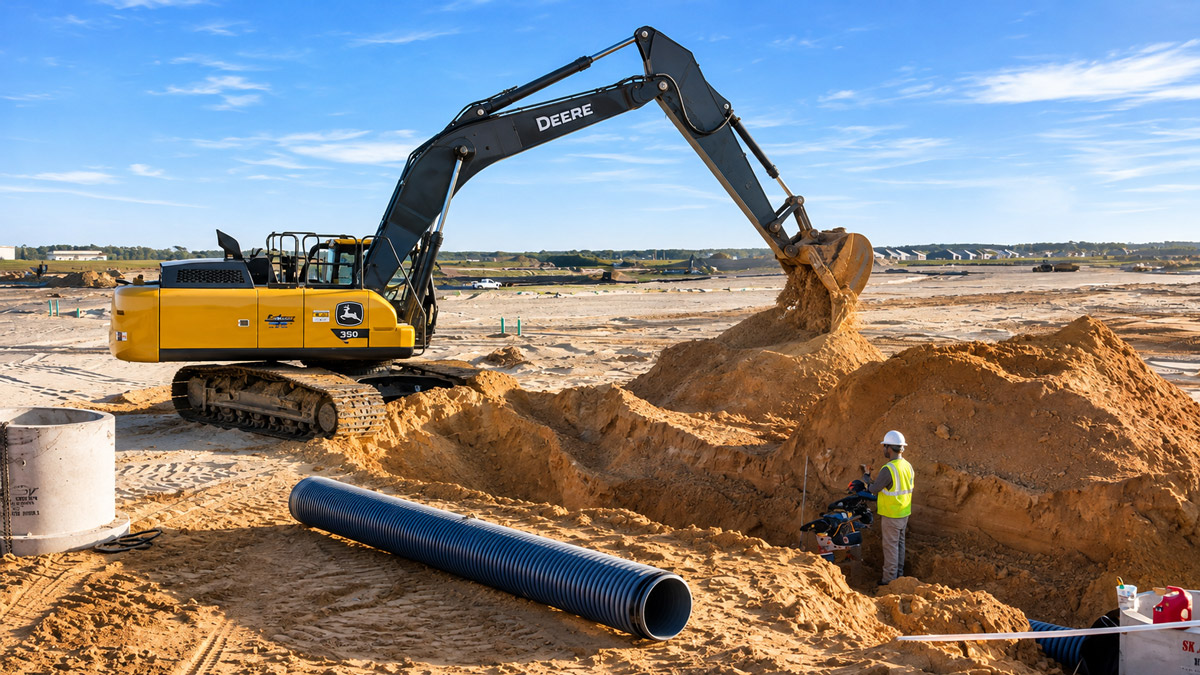
Commercial site utilities are the underground infrastructure systems that support a development's operation, including water distribution, sanitary sewer, stormwater drainage, and other utility networks required by the project.
For developers planning warehouses, industrial facilities, commercial centers, and residential communities in Central Florida, utility installation is a critical part of preparing land for construction.
These systems must be coordinated with grading, drainage design, roadway construction, existing infrastructure, inspections, and the overall development schedule. Understanding that coordination early can help prevent costly conflicts during construction.
What are commercial site utilities?
Commercial site utilities are the infrastructure systems installed to serve a development and connect it with existing public or private utility networks.
The exact scope depends on the property, intended use, approved engineering plans, and utility provider requirements.
Common site utility systems include water mains and service connections, sanitary sewer infrastructure, stormwater drainage systems, underground structures, and associated piping.
Electrical, telecommunications, gas, and other utility systems may also be part of a development, although these are often installed by specialized providers or contractors.
1. Underground utility planning begins before excavation
Utility installation should be considered during the earliest stages of site development planning. Existing infrastructure, connection locations, utility easements, required service capacity, and the proposed site layout can all influence the construction plan.
Civil engineers and utility providers establish requirements for system design, while the construction team evaluates how the work can be completed in the field.
Utility planning should also account for road alignments, building locations, stormwater facilities, and construction access.
Identifying potential conflicts early helps developers reduce the likelihood of redesigns or field changes.
2. Water infrastructure must support the development
Commercial developments often require water distribution infrastructure designed to serve the property's intended use.
Depending on the approved plans, this work may involve installing water mains, service connections, valves, hydrants, and associated structures.
The design and installation requirements depend on the applicable utility provider, local regulations, and the demands of the proposed development.
Before installation, the project team should confirm approved connection points, required materials, testing procedures, and inspection responsibilities.
3. Sanitary sewer installation requires precise coordination
Sanitary sewer systems collect and convey wastewater from a development to an approved treatment or collection system.
Installation may include sewer mains, service laterals, manholes, and other structures specified by the engineering plans.
Gravity sewer systems require careful attention to pipe elevations and slopes. Other systems may involve additional mechanical infrastructure and specialized requirements.
Utility contractors must coordinate excavation, bedding, pipe installation, backfill, compaction, and inspections according to the project's specifications.
Because these systems are installed underground, errors can become difficult and expensive to correct after subsequent construction is completed.
4. Stormwater drainage is essential to site performance
Stormwater management is a major consideration for commercial site development in Florida.
Rainfall must be managed through systems designed to meet applicable drainage and water-management requirements.
Depending on the project, stormwater infrastructure may include drainage pipes, inlets, manholes, control structures, retention or detention areas, and related improvements.
These systems must work with the site's engineered grades and planned surface improvements.
A drainage conflict can affect roadways, parking areas, building pads, and surrounding properties, making coordination between grading and utility crews particularly important.
5. Existing underground utilities can create construction risks
Not every development begins on completely undeveloped land. Existing water, sewer, drainage, electrical, gas, and communications infrastructure may already cross or border the property.
The construction team must account for known utilities and follow appropriate locating and verification procedures before excavation.
Utility records and surface markings do not always provide complete information about actual field conditions.
When conflicts or unknown infrastructure are encountered, the project team may need additional investigation, coordination, or design input before proceeding.
6. Utility installation must be coordinated with mass grading
Underground utilities and mass grading are closely connected.
The finished elevations of roads, building areas, drainage structures, and other improvements influence underground utility design.
At the same time, utility trenches and structures can affect the sequencing of earthwork operations.
Construction teams must coordinate excavation, pipe installation, backfill, and compaction with the overall grading plan.
Poor coordination can result in unnecessary rework or conflicts with subsequent site improvements.
7. Road construction depends on underground infrastructure
Underground utility systems are frequently installed beneath or near proposed roads and paved areas.
Required utility work, testing, and inspections should be coordinated before final roadway construction proceeds.
Excavating through a completed roadway to correct an avoidable utility issue can increase costs and disrupt construction.
This is one reason developers benefit from sitework teams that understand the relationship between underground infrastructure and road construction.
8. Testing and inspections are part of the process
Underground utility installation is not complete simply because pipes and structures have been placed in the ground.
Depending on the system and governing requirements, testing and inspections may be necessary before acceptance or subsequent work.
These activities can involve pipe testing, compaction verification, inspections, and documentation.
Developers should establish who is responsible for coordinating tests, obtaining inspections, and resolving deficiencies.
How long does underground utility installation take?
The duration depends on the size and complexity of the utility systems, trench depths, soil conditions, existing utilities, inspection schedules, material availability, and weather.
A smaller commercial property requiring limited connections may involve much less work than a large industrial development with extensive drainage and utility networks.
Developers should request a project-specific construction schedule that identifies utility installation activities and their dependencies on other sitework phases.
Why in-house utility crews can benefit developers
Utility installation must be coordinated with grading, road construction, and other site operations.
A site development contractor with its own pipe crews may have greater direct control over staffing, equipment allocation, and coordination between construction phases.
That operational control can be valuable on large projects with overlapping work activities and demanding schedules.
However, developers should still evaluate crew availability, qualifications, supervision, and demonstrated experience with similar utility systems.
Salser Construction's site utility capabilities
Salser Construction is a family-owned commercial site development contractor serving Ocala, Marion County, and Central Florida since 1998.
The company has completed more than 500 projects and performs approximately 90% of its work in-house.
Salser operates dedicated pipe crews alongside its grading, road construction, concrete, and paving operations.
This allows underground utility work to be coordinated with the company's broader commercial site development activities.
Questions developers should ask before utility construction
Before work begins, developers should confirm which utility systems are included in the contractor's scope and which responsibilities belong to utility providers or specialized contractors.
They should also review connection requirements, existing utility information, easements, inspection procedures, testing responsibilities, and construction schedule dependencies.
Clear coordination between the developer, engineer, utility providers, and site development contractor helps establish realistic expectations before excavation begins.
Building infrastructure that supports the entire development
Commercial site utilities are among the most important systems installed during land development.
Water, sanitary sewer, stormwater drainage, and other underground infrastructure must be coordinated with grading, access, road construction, and the property's intended use.
For developers planning commercial, industrial, warehouse, and residential projects in Central Florida, Salser Construction provides commercial site development services that include underground utility installation and related civil construction work.