
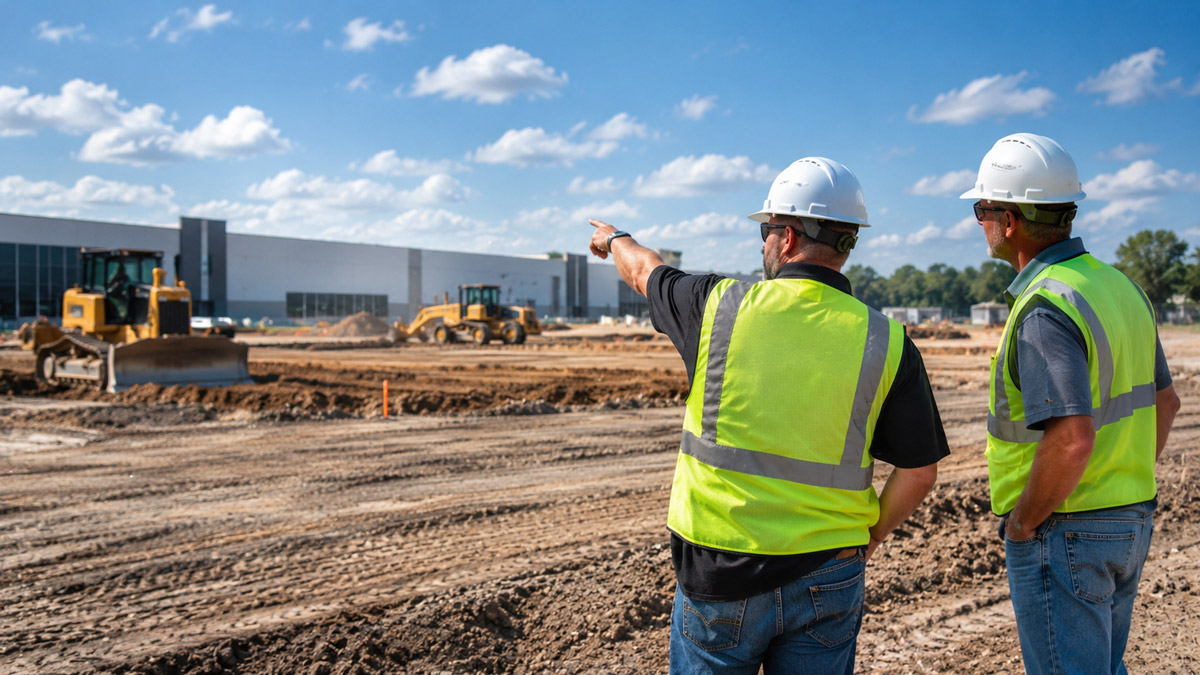
A successful commercial development starts long before the first building goes vertical. The quality of the sitework affects everything that follows—from access and drainage to utilities, scheduling, and construction costs.
For developers evaluating contractors in Central Florida, the decision should involve more than comparing bids. The right partner needs the experience, resources, and accountability to prepare the property for the next phase of construction.
1. Experience with projects of similar size and complexity
A contractor's experience should match the demands of the development. Preparing a small commercial parcel is different from coordinating mass grading, underground utilities, roads, and paving across a large industrial or residential project.
Ask prospective contractors about completed projects that resemble yours. Look beyond the number of projects and discuss their responsibilities, the challenges encountered, and how those challenges were resolved.
Salser Construction has completed more than 500 projects since its founding in 1998, with experience across commercial, industrial, and residential development in Central Florida.
2. The ability to perform critical work in-house
Many site development projects involve multiple specialties: excavation, grading, utilities, road construction, concrete, and paving. How those activities are staffed and coordinated can influence both efficiency and accountability.
A contractor with established in-house crews can often coordinate transitions between phases more directly and reduce dependence on outside subcontractor schedules. That does not eliminate project risk, but it gives the contractor greater control over important parts of the work.
Salser performs approximately 90% of its work in-house, including concrete and paving with its own crews. Developers should ask every prospective contractor which portions of their project will be self-performed and which will be subcontracted.
3. Equipment, materials, and supply coordination
Even a well-planned project can face delays when essential materials or equipment are unavailable. Before selecting a contractor, understand how they plan to secure the resources needed for the job.
Questions worth asking include how materials are sourced, whether the contractor has dedicated equipment, and how potential supply disruptions are addressed.
Salser's material resources include Shores Sand Mine LLC and Newberry Limestone LLC, which supply materials for Salser projects as well as outside customers. These resources are part of the company's broader approach to coordinating site development work.
4. A realistic schedule and coordinated execution
Sitework often sits on the critical path of a development. If grading, drainage, or utilities fall behind, the delay can affect multiple contractors working later in the construction sequence.
Ask for a realistic schedule that identifies major phases, dependencies, and decision points. The contractor should be able to explain how crews will be allocated, what information is needed from the developer, and how changes will be communicated.
An aggressive completion date is not necessarily a reliable one. A credible schedule should reflect actual site conditions, project scope, and available resources.
5. Bonding, insurance, and financial readiness
Large commercial developments can create substantial financial obligations. Developers should confirm that prospective contractors can meet the project's insurance, bonding, and contractual requirements before work begins.
Request documentation appropriate to the project and review it with the relevant legal, insurance, and financial professionals. Bonding requirements and available capacity should be verified for each individual contract rather than assumed.
6. Communication and accountability
Site development involves changing field conditions, coordination with engineers and inspectors, and decisions that may affect cost or schedule. Clear communication is essential.
During the selection process, establish who will manage the project, who has authority to make decisions, and how progress, issues, and change orders will be reported.
Pay attention to how clearly the contractor answers questions before the contract is signed. Transparency during preconstruction can be an important indicator of how the working relationship will function later.
Choosing a partner, not simply a price
Price matters, but a bid should be evaluated alongside scope clarity, experience, staffing, resources, and execution strategy. The lowest initial number may not represent the best overall value if important work, assumptions, or risks are not clearly addressed.
The goal is to select a contractor who understands the development, communicates expectations, and has the capabilities to deliver the required sitework.
For developers planning projects in Central Florida, Salser Construction brings decades of field experience, established in-house crews, and a broad range of site development services to the conversation.